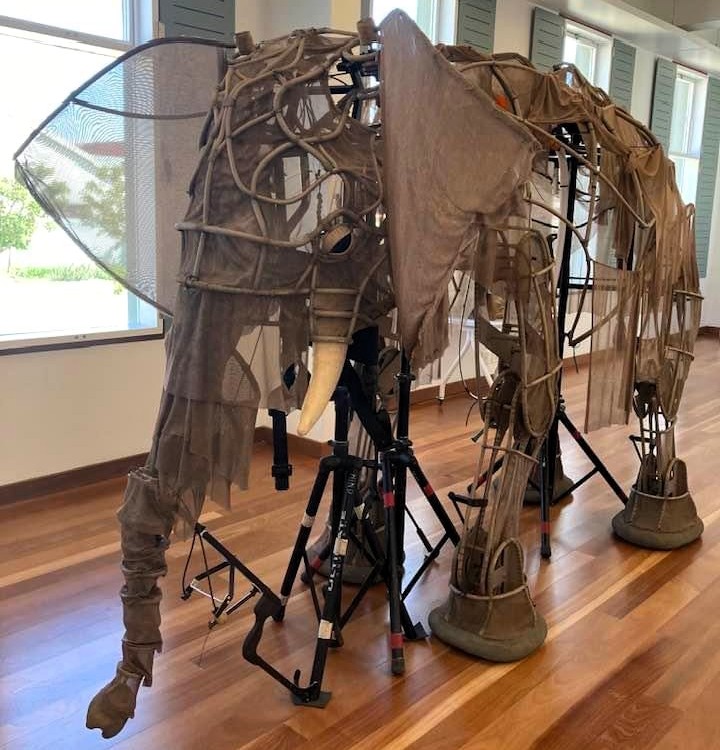
In April last year, I attended a conference marking the 50th anniversary of the publication of J.M. Coetzee’s first novel, Dusklands. It was a memorable event, not only for the rich discussions surrounding the book, but also for the space in which it was held: the University of the Western Cape’s Woodstock Campus, at 66 Greatmore Street.
The building, which hosts UWC’s Centre for Humanities Research, is an exceptional interdisciplinary space, bringing together scholarly pursuits and creative practice. Below us, while we spoke about Coetzee’s novel, we heard (faintly) the thudding of hammers: the Ukwanda Puppets and Designs Art Collective were building life-size animals for The Herds, an extraordinary public art initiative that saw a giant “herd” of puppet animals marching from Kinshasa to the Arctic Circle earlier this year, drawing attention to climate change.
In my paper, I tried to think through what it entails to read Coetzee’s first novel from a ‘planetary’ perspective. The essay, since redrafted (& with many thanks to the patient, encouraging editors), has now been published in a handsome double issue of English in Africa devoted to the conference.
It’s incredibly hard to say something new about Coetzee’s work, or to try a tack that’s not yet oversaturated with perspectives and opinions. Building on themes that others have also identified in his novels (especially Life & Times of Michael K: see here and here and here), I’ve steadily been trying to develop a broadly ecological, or ecocritical approach to his writing. Here’s the abstract of my attempt to do so with Dusklands:
Here’s a link to the paper, for anyone interested in reading it (feel free to get in touch for a copy if the link does not bring joy).